The "I'll start tomorrow" problem.
Most people know stretching helps. They've Googled it, watched a video or two, maybe even bought an app. And then they stop after three days.
Reading through threads on r/Fitness, r/bodyweightfitness, and r/flexibility, the same complaints kept coming up: too much choice, no guidance on what's right for the problem you actually have, and apps that feel built for fitness pros — not regular people with sore backs.
"I never know which stretches actually target my problem vs just wasting my time." r/Fitness
The opportunity I saw: cut the decision-making out of stretching. Make the answer to "what should I do right now?" feel obvious.
Not gym pros. Real people.
I deliberately scoped the audience away from the fitness-influencer crowd. StretchSmart is for the person who sits at a desk all day, the parent whose back hurts from picking up kids, the runner who knows they should stretch but never does.
That audience choice drove almost every other decision: the tone of the copy, the size of the routines, the fact that there's no "advanced" mode, and the explicit promise on the landing page — "Built for real people, not gym pros."
AI as leverage, not the pitch.
There are already plenty of stretch-routine libraries on the App Store. Going head-to-head on content depth wasn't a fight I could win. So I framed the product around a different question: what can AI do here that a content library structurally can't?
The answer was personalisation. A user describing "tight lower back from sitting all day, 5 minutes, beginner" should get a routine built for that — not a generic playlist filtered by tag.
Option A — Content-first app
Curated library of routines, sorted by tag. Cheaper to build. Hard to differentiate against incumbents.
Option B — AI routine builder + library
Free, full-access library and AI builder for everyone — then a single subscription once they're hooked. Library proves quality; the AI builder is what people stay for.
This shaped the pricing too. Rather than splitting features into free vs. paid, I went with a free 14-day trial of the whole app — every routine, the AI builder, full tracking — then a single $6.99/month subscription. The bet: let people feel the full value first, and the ones for whom it clicks will happily pay to keep it.
Six features. One promise.
I held the feature list back hard for v1. Every feature has to serve a single promise: "up and stretching in three steps." Anything that didn't earn its place there got pushed to a later release. Every one of these is included in the free trial and the subscription — no feature gating.
Targeted library
Routines by problem area — lower back, knees, shoulders, desk posture.
AI routine builder
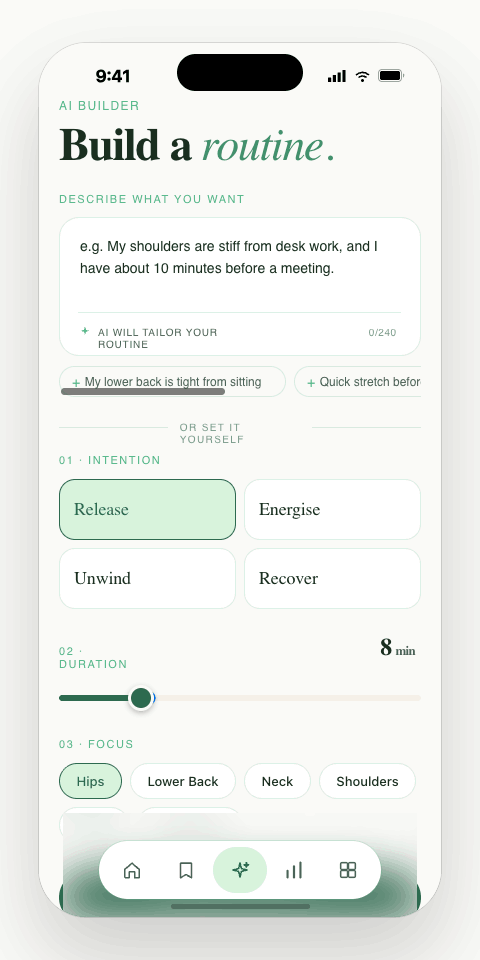
Describe your problem in plain English. Get a routine built for you in seconds.
Daily habit tracker
Tick each day. Watch the streak grow. The simplest possible loop.
Guided sessions
Step-by-step illustrations with countdown timers. No thinking required.
Daily reminders
Set your stretch time once. We nudge you gently every day.
Progress dashboard
Longest streak, total minutes, calendar history. Consistency at a glance.
Three taps from sore to stretched.
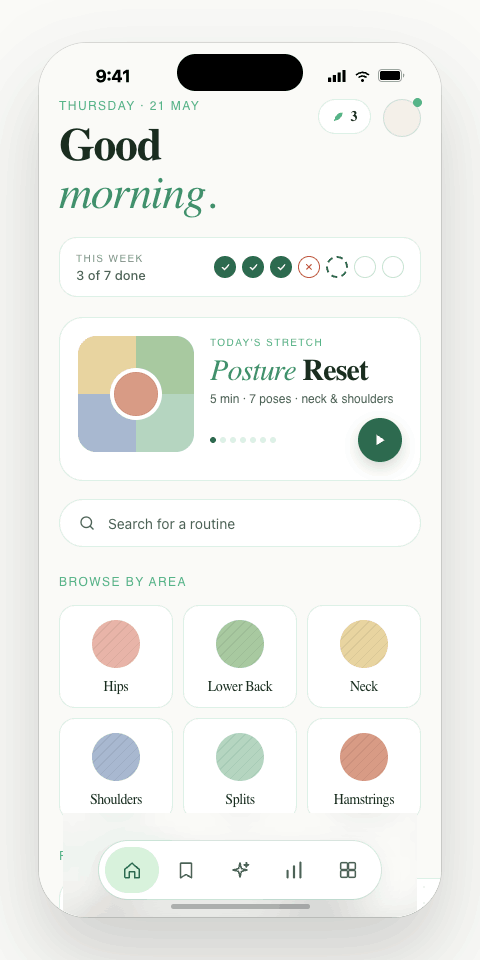
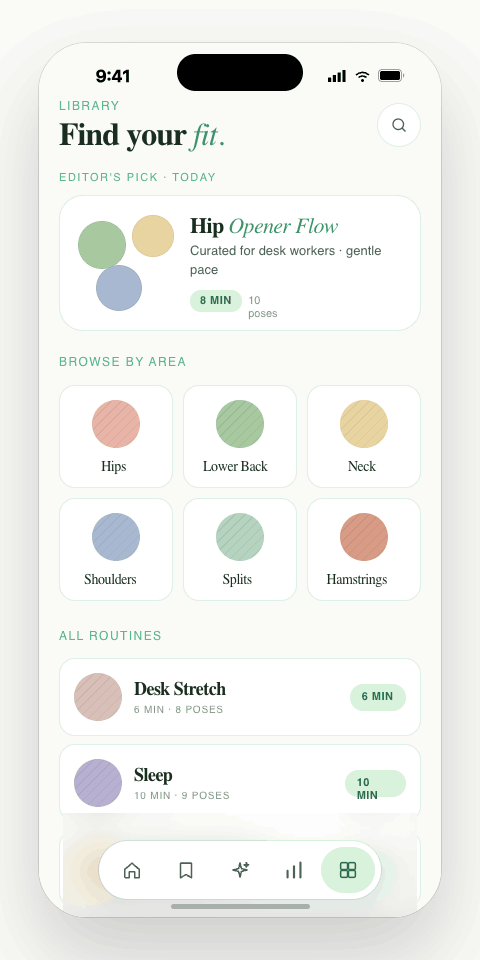
The current build, on a real iPhone — a calm daily home, a library you browse by body area, and an AI builder that turns plain English into a tailored routine.
Pre-launch, building in public.
I'm being honest here: StretchSmart is currently in waitlist mode. The landing page is live, early members are signing up, and the iPhone app is in development. There aren't real launch metrics yet, and I'd rather show you my thinking than invent numbers.
Problem & audience definition
Read through fitness/flexibility subreddits, mapped recurring complaints, defined the "real people, not gym pros" positioning.
Landing page & waitlist
Shipped a landing page that explains the value in plain English. Currently collecting early members.
MVP build
iPhone app: library, tracker, timer, reminders, and the AI routine builder. Scoping ruthlessly to ship something small but real.
Closed beta & eval loop
Get the AI routine builder in front of 20–30 real users. Set up a simple quality rubric so I can tell when generated routines are good vs. wrong.
Public launch
App Store launch with a clear 14-day-trial → subscription story. Watch the funnel, learn, iterate.
Three things I'm carrying forward.
- 01Audience choice is a product decision.Saying "real people, not gym pros" out loud changed everything downstream — copy, scope, pricing, what to leave out. The clearer the audience, the easier every other call gets.
- 02AI is leverage, not the pitch."AI-powered" is not a value prop. "Tell us where it hurts, get exactly what you need" is. The model is a means; the relevance is the product.
- 03Build the smallest honest version.It's tempting to add features to make a landing page look richer. I cut hard, because every feature is a promise — and one I'd have to deliver on. Better to ship six things well than sixteen things hopefully.